
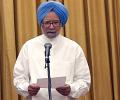
Former Indian Prime Minister Manmohan Singh's effusive praise of US President George W Bush during their 2008 meeting in the White House is revisited as a testament to their close relationship and the impact of the landmark Indo-US civil nuclear deal. Singh's statement, while drawing criticism from the Left and BJP, highlighted the transformative nature of the relationship between the two democracies. The article explores the context of their meeting and the broader significance of their relationship in the context of the Indo-US nuclear deal.
Pakistan on Thursday expressed hope that the agreement between Iran and Western powers on Tehran's nuclear programme would pave the way for faster implementation of an ambitious bilateral gas pipeline project.

'The RSS, that advocated military strength, remained in the ideological doghouse for over half a century. Many of the RSS' responses even today carry the burden of this past,' points out Colonel Anil A Athale (retd).

The Army Chief said India's political brass has the will to strengthen the country's deterrence capabilities.
Both countries have always supported the peaceful use of civil nuclear energy and an agreement in this connection is expected to be signed during the President's visit to China which began Tuesday, Ambassador Masood Khan said. The two countries will ink several agreements in the fields of technology, agriculture and minerals. They will also sign an investment protocol to their existing free trade agreement to boost investments in Pakistan, he told Geo News channel.
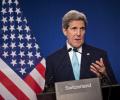
At scaling back Tehran's nuclear programme and relieving the Islamic Republic from the sanctions
Dismissing the perception that Prime Minister Manmohan Singh and United Progressive Alliance Chairperson Sonia Gandhi have backtracked on the India-United States nuclear agreement, the Congress on Friday said that it has not changed its stand and everyone is adhering to the coalition dharma. "The Congress' stand is the same. However, at the same time, we have to abide by the consensus among our allies and coalition partners," Congress spokesperson Abhishek Singhvi said.

On the table are additional batches of S-400 surface-to-air missile systems from Russia, which India used with immense success during Operation Sindoor. India could buy at least two squadrons of Su-57 fighter jets plus joint production of S-500 air defence systems.
Administration sources said a signing ceremony would take place on Monday, December 11 with President George W Bush signing the bill into law.
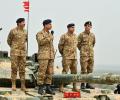
'Can a nuclear-armed nation sustain itself indefinitely under overt military rule without catastrophic consequences for itself and the region? History suggests otherwise.'
The Barack Obama administration is resigned to the reality that the Manmohan Singh government has little chance of salvaging the deal from the limbo it is in now and providing some leeway on the Nuclear Liability Law, experts tell Aziz Haniffa

The talks could be a last-ditch diplomatic effort to avert a military strike on Iranian nuclear installations and could also help President Barack Obama make the case that he is nearing a breakthrough in the decade-long effort by the world's major powers to curb Tehran's nuclear ambitions.

US President Donald Trump has claimed he played a key role in defusing tensions between India and Pakistan by threatening to impose massive tariffs, saying the move "stopped the fighting" between the two nuclear-armed neighbours.
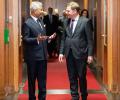
External Affairs Minister S Jaishankar has asserted that India has zero tolerance for terrorism and will never give in to nuclear blackmail, emphasizing that New Delhi will deal with Pakistan purely bilaterally. He made these remarks during a joint press conference with his German counterpart in Berlin, where he also highlighted the importance of the strategic partnership between India and Germany, emphasizing the need for a free trade agreement between the two nations.
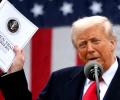
'The real story of 2025 is that India officially stopped being a 'market of the future' and started acting as the world's primary economic engine.'
An India-Japan civil nuclear pact would be critical in signalling that they would like to build a partnership to bring stability to the region at a time when China is going all out to reward Pakistan with civilian nuclear reactors, says Harsh V Pant.
Prime Minister Manmohan Singh's presence at the first-ever Nuclear Security Summit hosted by United States President Barack Obama, beginning April 12, will be key for 'critical substantive reasons', believes Dr Ashley J Tellis, an expert on nonproliferation and nuclear security matters.
A book comprising a collection of articles penned by Communist Party of India-Marxist's General Secretary Prakash Karat trashes the deal.
India's offer of the reported proposal to put a dedicated facility under safeguards, could be a positive contribution to moving the process forward during the talks led by Narayanan, predicts Dr Ashley J Tellis.
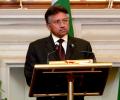
'The United States loves working with dictators' 'Because then you don't have to worry about public opinion and you don't have to worry about the media anymore'
The CPM on Monday decided to explore avenues to resolve its differences with the UPA government about the Indo-US nuclear agreement. the party stopped short of saying it would withdraw support if the govt goes ahead & operationalises the pact.
"In our dialogue with the Pakistani government, we have clearly said we will work with them on civil nuclear energy," Clinton told a group of Pakistani journalists in Islamabad on July 19, according to the transcripts made available by the State Department.
In a major breakthrough in its quest for nuclear technology, India will launch talks with Japan from Monday to seal a civilian atomic cooperation pact that will pave the way for the sale of advanced technology by Japanese firms like Mitsubishi and Hitachi. Terming the development as 'very positive', sources said for Japan, the only country ever attacked with atomic weapons, the decision to go ahead with such a pact with a non-Nuclear Non-Proliferation Treaty signatory country

Russian President Vladimir Putin will make a two-day visit to India from December 4 to hold annual summit talks with Prime Minister Narendra Modi that is expected to produce a plethora of significant outcomes, including in the defence sphere, to further solidify the bilateral strategic ties.
Over 90 Indian-American community leaders and political activists, who were catalytic in pushing through the passage of the legislation, took part in the ceremony in the East Room of the White House.

Trump also repeated his claim that seven fighter jets or more were shot down during the hostilities.

US President Donald Trump has repeated his claim of "stopping" the conflict between India and Pakistan through trade and tariffs, and suggested he deserves the Nobel Peace Prize for settling multiple conflicts.
Donald Trump claimed that his intervention prevented a war between India and Pakistan, citing trade negotiations as leverage. India has refuted claims of US mediation in past conflicts.
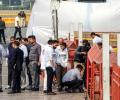
US Secretary of State Marco Rubio praises India's measured and professional investigation into the Red Fort car explosion, calling it a terrorist attack. The US has offered assistance, but acknowledges India's capabilities in handling the investigation.

In response to US criticism of India's oil imports from Russia, the Indian Army shared a 1971 news clip highlighting the US's role in arming Pakistan.

The Russians have termed Putin's visit to India, his first to this country since the outbreak of the Russia-Ukraine war, as 'Druzhba Dosti', which means 'friendship' in Russian and Hindi respectively.
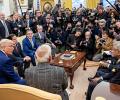
During the talks, India and the US decided to take a big leap in broad-basing their strategic ties in several critical areas.
India would have to present a credible plan of separating civil and nuclear establishments before the American Congress decided on lifting of sanctions on it, says Mulford.
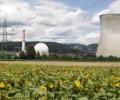
On the eve of his visit to Tokyo, Prime Minister Manmohan Singh has said that he hopes to strengthen strategic and global partnership with Japan and reach an early agreement with regard to civil nuclear energy cooperation.
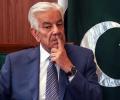
The entry of other Arab countries in the mutual defence deal between Pakistan and Saudi Arabia is not ruled out, Defence Minister Khawaja Asif has said, adding that 'doors are not closed' for such developments.
